What Steps Can Be Taken to Improve College Affordability
01
Foreword
College affordability is a complicated and multi-faceted challenge. The price students and families are asked to pay has steadily increased over the past several decades, despite the existence of federal, state, and institutional grant programs, which are ofttimes non sufficient to fill the gap in need. But as troubling, nigh students and families aren't given clear and useful information about what they should await to pay or how to navigate the system.
This is a challenge I worked on as a policy adviser in the Obama assistants, and I've continued to work on information technology during my time at Lumina Foundation. At Lumina, we've suggested that the conversation effectually affordability be reframed around a concept we've called the Affordability Benchmark. We need to make college affordable by focusing on the pupil first—not on what tuition is, not on what assistance is available—but on the educatee experience. Affordability should be defined by what is reasonable to wait students and their families to contribute toward their teaching, and this information should exist shared with them in clear and anticipated ways.
Nosotros demand activeness on the part of states, institutions, and policymakers at all levels to make this a reality. The steps laid out here by the Jack Kent Cooke Foundation are clear, cogent, and compelling action items that every institutional leader should take seriously. Well-resourced institutions, in item, should motility forrard quickly to implement these action items as evidence of their commitment to truly reshaping their practices in a way that benefit low-income students.
Ultimately, we need a amend organization of financing postsecondary education that frames affordability in a way that is clear and predictable, congenital effectually a defined benefit, and based on a reasonable contribution of resource available to students and families. The burgeoning path to a better reality for students has been made clear by this well-researched work—if institutions have these recommendations seriously, more students would likely enroll in college and exist financially successful while in that location.
Dr. Zakiya Smith
Strategy Director, Lumina Foundation
Former Senior Adviser for Educational activity in the Obama White Business firm
02
Introduction
College can seem out of reach for many depression-income students. As well often they believe higher is unaffordable and unattainable. It is no surprise then that students from the bottom socioeconomic quartile are 8 times less likely to earn a bachelor's degree than students from the top socioeconomic quartile (7.4% versus 60%).¹
Even our nation'due south brightest depression-income students, who have done very well in loftier school and score highly on standardized tests, are less likely to obtain a college degree than their higher-income peers, a discrepancy known as the "excellence gap."²
Several factors hinder students' access and success. Low-income students may lack agreement of how financial aid works, or perceive they are unable to meet the total costs of higher education. Depression-income students are more likely to suffer from "sticker shock" on seeing the ostensible price of a higher teaching, to attend colleges closer to dwelling house to save money, and to pursue choices that permit them to piece of work while in school. While country and federal funding can assist to offset college costs, low-income students often are unaware that institutional aid can significantly lower costs and in some cases make higher absolutely free. They exercise not empathize the value of institutional help, work/study policies, and loan forgiveness policies. They may not know how to use for institutional help required at some institutions, such as the completion of the College Lath's College Scholarship Service Profile and the Institutional Documentation Service (IDOC). Institutional help could potentially play a much more important office in increasing access and persistence among low-income students, if these gaps in knowledge were removed. Colleges and universities accept a part to play in educating low-income students about how to pay for higher.
This cursory offers 11 all-time practices to institutions to assistance students pay for college and stay in school. These strategies are organized into 3 categories: clarifying financial data, easing the fiscal brunt, and filling in financial help gaps. Specifically, we talk over how schools can provide students with improve data to assist them brand more informed choices, to make going to college more affordable, and to understand how fiscal aid programs work and then that they can maximize the aid they receive.
03
Clarifying Financial Data
The federal government has recognized that students have the right to data that can help them make the all-time decision regarding their education.³ Colleges thus make a range of data available to students, such equally the cost of omnipresence, graduation rates, and student body diversity. However, this information is disseminated in diverse means that are non always the well-nigh user-friendly for the individual pupil. Some facts are distributed to all enrolled and prospective students or are available online to everyone, while others are bachelor only upon request, or sent out in publications and mailings. Sadly, the data provided is frequently a confusing mess, and low-income students — often sorting through the data without a seasoned advisor at their side — must navigate these puzzles on their ain.
Information that is only bachelor upon request or through selected mailings puts low-income students at a disadvantage. Students may non be aware that the information fifty-fifty be, much less that they should be seeking these figures. Lack of understandable information puts depression-income students at a disadvantage, and they may incorrectly conclude that a college education is but unattainable or may enter college without a total agreement of how to navigate the many fiscal help programs, and ultimately drop out.
Schools should transparently provide all students with the relevant knowledge needed to make the best decisions about their education and paying for it. Schools can proactively support depression-income students past providing articulate, comprehensive data to all students, regardless of whether information technology is requested. This includes providing students with the most accurate figures available related to costs, financial aid, and student success, as outlined in our first five strategies below.
Strategy 1: Clarify financial assist messages
Accompanying many offers of admission is a financial aid award letter. These messages often apply acronyms and abbreviations, and they may lump together scholarships and loans in means that are difficult for students and families to sympathize.⁴ Variation in financial aid letters from school to school can go far hard for students and families to compare offers.⁵
To accost these issues and help families make more than informed decisions most college, the U.S. Section of Pedagogy and the Consumer Financial Protection Bureau developed the "Fiscal Aid Shopping Sheet" in 2012. This form was designed to simplify information regarding cost and financial aid and let students to easily compare institutions. Elements of this grade include:
- Separation of loans from grants and scholarships.
- A concise statement that grants and scholarships are gifts that do non need to be paid back.
- The sources of grants and scholarships.
- The net ("actual") toll of one twelvemonth'south tuition.
- Clear language (e.g., no abbreviations or acronyms).
In an open letter to college and academy presidents, the Department of Education asked institutions to adopt this form for the 2013–14 schoolhouse twelvemonth. As of January 2017, three,278 institutions — including threescore selective institutions — take obliged.⁶ A copy of the class and a list of participating schools can exist constitute on the U.S. Section of Education website. More schools are using this form every year. Schools should at the very least utilize it as a template to clarify the elements of their fiscal aid so students can compare offers.
Institutional award letters should make clear:
- The amount of grant aid the pupil is receiving, with clear language indicating that grants are gifts that do not need to be paid back.
- The source of each grant.
- Possible additional sources of funding (e.yard., private scholarships) to pay the net cost (the difference between price of omnipresence and grant aid).
- Clarification that loan amounts are suggestions, not requirements.
- A articulate statement of how much coin the pupil and family will demand to pay, including an explicit statement that loans must be repaid.
- The net cost of attendance.
In addition, schools should make clear the terms of continuation of any aid:
- The requirements for maintaining each form of grant funding, such every bit form point boilerplate requirements or minimum credit load requirements.
- A disclosure as to which grants must be renewed annually (including federal or country aid) with instructions on how to renew the assist.
Strategy 2: Provide students with a four-twelvemonth estimate of expected costs
Unexpected rises in tuition can derail students, specially those who may already exist struggling financially to stay in school. Only informing potential students that tuition prices may increase is not sufficient. While schools cannot be expected to know the exact tuition costs of future years, schools can project potential increases in tuition to assist students make informed decisions and gear up for the next four to six years. Giving students an idea of the price of education for the duration of their schooling can allow students to budget and plan for potential tuition increases well in advance. Some schools take begun offering this information on their financial assistance websites. Other schools tin prefer these best practices:
- Towson University projects 4-year academy costs for fall 2022 through 2020.
- Manhattan School of Music provides estimated projected price of attendance for 2017–xviii through 2021–22.
- Culver–Stockton College provides estimated annual costs for the 2018–nineteen and 2019–20 school years.
- Equally of Fall 2017, several schools provide cost of attendance for the 2017–18 and 2018–xix bookish years. For instance, Sweetness Briar College and Wesleyan College both provide information on two years of tuition and other costs.
Supplying future price estimates is useful for students as they explore diverse colleges. An optimal solution would exist a calculator that could approximate each private student's potential cyberspace cost (incorporating financial aid) over the course of college.
Strategy 3: Plant articulate policies regarding financial aid eligibility requirements
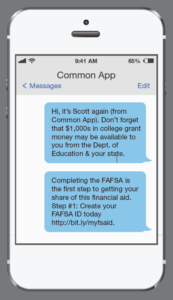
Effigy 1: FAFSA Text Reminder from the Common App. Source: "Using Texts to 'Nudge' Students on Financial Assistance," Teaching Week, October 11, 2016.
Most students who lose their eligibility for student financial aid do and then because they lack the necessary grades, and therefore are unable to meet the "satisfactory bookish progress" requirements of their aid programme.⁷ Nether the Student Right-to-Know Act, schools must make the conditions of satisfactory academic progress "available" to all do good recipients.⁸ Yet, schools can meet the requirements of the statute in a number of ways. The most directly manner would be by including these requirements in the same envelope with their fiscal assistance award letters, but not all schools cull this option. Instead, schools ofttimes make this information available through publications or online.
Once students are enrolled, institutions should remind them periodically of requirements and deadlines. The Gratis Application for Federal Student Aid (FAFSA) class is a requirement for the Pell Grant, the federal government'southward plan for the most financially-strapped students, and for a number of other public and private scholarships. FAFSA completion is important for maintaining various forms of help. Students are not ever enlightened that FAFSA must exist completed annually in order to go on receiving need-based aid. Schools should remind students of specific FAFSA deadlines. Research suggests that depression-cost interventions, such as text reminders, amend students' completion of FAFSA and other higher related tasks.⁹ Many schools already communicate important information, such as emergencies, to students through e-mail, text, and automated messages (Effigy one). Transmitting reminders about fiscal aid deadlines would benefit many who would otherwise drop out.
?Schools Offering Fiscal Aid Text Notifications
- Wayne State University
- Vernon College
- Rio Hondo College
Strategy 4: Constitute more robust methods for estimating non-tuition costs
Half of all undergraduates (50 per centum) alive off campus, while the residue live on campus or at home.10When providing financial assistance, colleges are required to guess living costs for students who are living on their own. Nonetheless, estimating off campus housing costs tin can be challenging, resulting in dramatic variation of estimates of off-campus living costs among colleges, even between colleges in the aforementioned metropolis. Researchers have plant, for example, that college estimates of living costs in Washington, DC ranged from $9,387 to $20,342, while colleges in Milwaukee have estimated costs ranging from $5,180 to $21,276.11Furthermore, researchers have estimated that one-third of colleges underestimate living expenses.12The estimation of living costs has disquisitional implications for students who depend on financial assist. Underestimationof living expenses tin mean insufficient financial aid; overestimation can lead to students borrowing more money than they need.
Many schools survey students to obtain information on living costs. These surveys do non accurately estimate costs, considering they capture what students are spending as opposed to what they demand to spend.13Under-resourced students may underreport costs, because they are missing meals, sleeping in their cars, or burrow surfing.fourteenA survey of undergraduates at the University of California, Berkeley found that 23 percent of students reported skipping meals at least somewhat often to salve money.15On the other hand, wealthier students may study college living costs than necessary.16
When estimating off-campus living expenses, schools should apply standardized information or validate pupil-reported information with standardized data, such as information from the U.Due south. Department of Housing and Urban Development, U.Southward. Department of Agriculture Food Plans, and the U.Southward. Agency of Labor Statistics. The significance of this information is too important to get wrong.
Strategy 5: Educate students about fiscal assistance
Relatively few students accept even minimal knowledge about fiscal aid. According to the 2022 Administrative Budget Survey, administered past the National Association of Student Financial Aid Administrators (NASFAA), over 70 percent of administrators at four-twelvemonth institutions reported that students' financial literacy was "limited."17Knowing the source and requirements of financial aid enables students to brand amend financial planning decisions.
Schools should encourage or require students to run across with a financial help adviser before signing off on fiscal aid packages to ensure students sympathize their packages and make informed financial decisions. One report of fiscal aid recipients plant that when students sought fiscal aid advising, they constitute it useful.18Alternatively, schools should also offer webinars or videos that walk students through an instance of a fiscal help letter and talk over mutual questions or problems that students confront to help them meliorate understand their financial aid packages.
Some processes that ostensibly aid facilitate blessing of grants are problematic. For example, there are online systems that permit students to sign off on their fiscal assistance packages without fully examining or understanding them. Further, a student'due south parent may independently concord to a financial help package if a pupil has consented to permit their parents access to their fiscal aid information. Parents should not be allowed to consent to burdens imposed on their children.
Examples of Financial Assistance Educational Resources Offered by Schools
- Stony Brook Academy (SUNY)
Financial assistance YouTube folio roofing a range of topics, including "Accept and Decline Aid" and "SBU Satisfactory Bookish Progress Guidelines." - University of California at Berkeley
YouTube page offers videos addressing diverse financial assistance topics. Videos include a tutorial of UC Berkeley'south financial assistance system. - University of Wisconsin-Milwaukee
Presentations for students and parents.
04
Easing the Financial Burden
As noted, rising higher costs can brand higher education seemingly unattainable for depression-income students. They are more likely to forgo higher pedagogy entirely due to perceived financial constraints.19 It is no surprise that low-income families are more probable to find financial assistance disquisitional in selecting a higher, particularly in light of the loftier cost of a college instruction.xxThese students' higher choices may be limited to what they can beget rather than the best fit. For high performing, low-income students, this may mean sacrificing selectivity.
Once enrolled in college, low-income students are more than likely to leave without obtaining a degree. Insufficient funds to meet bones needs and the requirement to work while in schoolhouse contribute to the increased rate of attrition.21
Schools tin can assistance to ease the burden of financial stress and back up low-income students in multiple means, outlined in strategies half dozen through nine below.
Strategy 6: Prioritize demand-based institutional grants
Over the final 20 years there has been a shift towards merit-based scholarships and away from need-based assist. In 1995, the majority of institutional accolade dollars were need-based.²² Still, by 2003 the majority of institutional award dollars were merit-based.
Non-need-based assistance, such as merit scholarships, is likely to attract students who tin beget to pay for college. It also attracts students who are at the top of their class.²³ Accordingly, merit-based awards benefit institutions, but they tin exacerbate the excellence gap by limiting aid to students who may demand information technology the most.
In other words, wealthier students may exist getting more aid than they need, while low-income students are unable to meet fifty-fifty their minimum financial requirements. A study by Postsecondary Educational activity Opportunity suggests that students from lower-income families had greater unmet demand than their higher income peers.²⁴ Some other report establish that more than than a quarter of students from the top income quartile, or students from families that can afford to pay for college, received merit grants.²⁵ Appropriately, institutional assistance that is used for merit aid hurts low-income students while not materially helping wealthier students every bit they have little to no financial need.
Institutional assist is an important source of fiscal help, particularly among students attending private institutions (run into Figure 2). In 2011–12, 67% of the aid received by students attending private 4-year colleges came from institutional grants, and 25% of the aid received by students at public four-twelvemonth colleges came from institutional grants.²⁶
Closer examination of private colleges and universities shows varying practices in institutional aid. At the lowest-priced private institutions, low-income students actually receive less institutional help than students from college-income families, because of the merit aid awarded to high-income students. Unsurprisingly, at the highest-priced institutions, low-income
students, on average, receive almost double the institutional assistance than students from the highest income quartile (see Figure iii).²⁷
Additionally, high-income students are significantly more than likely to obtain funding that exceeds their need (see Table i).²⁸ Students in the highest-income bracket attending private four-year institutions received an average of $5,800 in assistance exceeding their need. Most one-half (45 percent) of students from the highest-income brackets that attended private institutions received grant aid beyond what their need dictates.
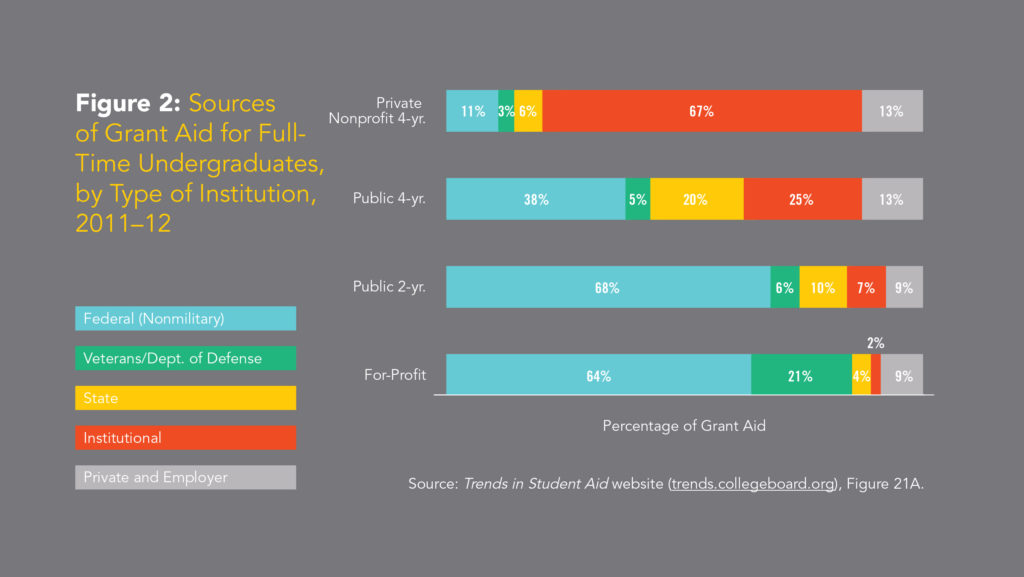
Figure 2: Sources of Grant Aid for Full-Time Undergraduates,by Type of Institution, 2011–12
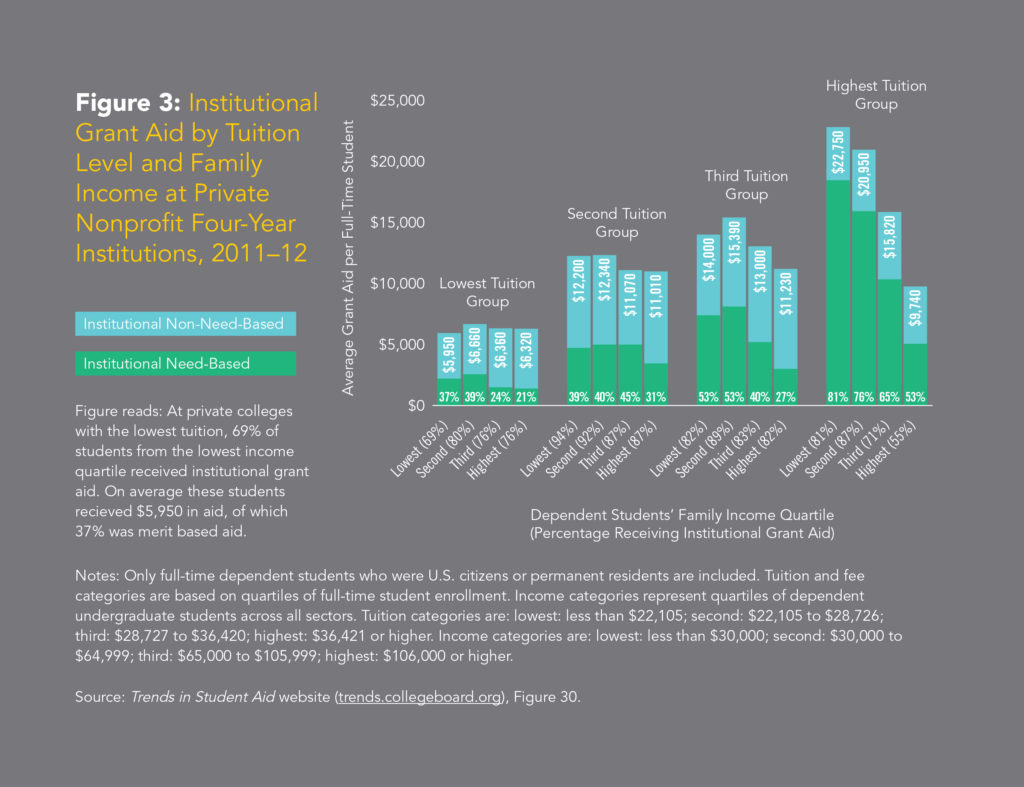
Figure 3: Institutional Grant Help by Tuition Level and Family Income at Private Nonprofit 4-Year Institutions, 2011–12
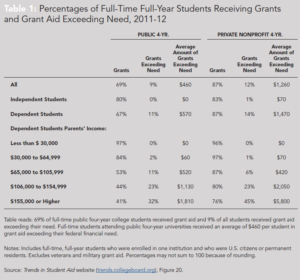
Table 1: Percentages of Full-Time Total-Year Students Receiving Grants and Grant Assist Exceeding Need, 2011-12
Strategy 7: Commit to maintaining grant levels for the elapsing of a pupil'southward academic program
Students entering college may assume that grant funds will be stable throughout their higher years. However, enquiry indicates that institutional grant help at private universities decreases past an average of $1,000 betwixt freshman and senior year.²⁹ Merely equally unexpected tuition increases can derail students,³⁰ unexpected losses in grant funds can potentially interfere with a student'south educational progress, especially when loss of grants are coupled with increases in tuition and fees. Schools should seek to maintain grant funds throughout the course of a student's academic programme, provided the educatee maintains minimum academic standards.
–Examples of Schools Committed to Maintaining Institutional Grant Levels for Four Years*
- Vassar College
- Grinnell Higher
*Grants may exist contingent on yearly application and changes in demand
–Examples of Schools Offering Need-Based Grants Only
- Vassar College
- Stanford University
- Harvard University
- Northwestern University
- Franklin and Marshall College
Strategy 8: Do not reduce institutional aid when students receive private scholarships
Private scholarships can help students meet unmet need and reduce debt. Many students seek such scholarships to brand college more affordable and to avoid taking loans. Withal, displacement of institutional aid undermines the purpose of private scholarships as the net price is non decreased and college does non become more affordable. In a survey of their scholarship recipients, the Dell Scholars programme found that sixty pct of scholarship recipients were adversely affected by accolade displacement.³¹ When schools engage in deportation, they limit the benefit of private scholarships, specially for low-income students. Scholarships should supplement institutional help, rather than supersede it.
–Examples of Schools with a Policy of Reducing Loans and/or Work Written report Before Institutional Grants
- Vassar College
- Grinnell Higher
- University of California at Berkeley
Strategy 9: Utilize low-cost textbooks
The toll of academic materials such as textbooks may place a burden on students with unmet financial demand. The average cost of textbooks has increased by 73 pct over the by decade, and an private textbook can price over $200.³² With virtually all courses requiring a textbook,³³ these materials tin add together up speedily. Students may exist forced to become without textbooks or purchase textbooks and make other sacrifices in return.
A report past the Lumina Foundation found that virtually instructors exercise consider the cost of textbooks when choosing form materials for their students.³⁴ Furthermore, faculty tend to be dissatisfied with the high cost of texts. One kinesthesia member from the study is quoted as saying, "At a fourth dimension when we are concerned about the cost of a university education and pupil debt, a $246 text is obscene." Open-licensed educational materials or open textbooks tin significantly reduce course fabric costs. Yet, the sensation of these culling resources among faculty tends to be low.³⁵
The U.S. Public Interest Research Grouping (U.S. PIRG) argues that institutions are well equipped to accost the issue of textbook prices through their libraries and back up staff. They suggest a number of ways that schools tin can encourage the utilize of openly licensed materials.³⁶ Their recommendations include:
- Expand open up textbook use on campus. Currently simply five percent of courses utilize an openly licensedrequired textbook.³⁷
- Implement policies that demonstrate administrative support of, but do not mandate, open textbooks as a possible choice for course materials.
- Develop programs that provide training and coaching around the utilise of open textbooks.
- Offer kinesthesia release time or stipends to explore open materials and contain them into their courses.
- Assign a chair or commission with the coordination of these efforts.
–Examples of Schools Providing Data Virtually Open Educational activity Resources
- Baruch College
- University of California at Berkeley
- University of Wisconsin-Madison
- University of Wisconsin-Milwaukee
05
Filling in the Gap
Even with financial assistance, some students nevertheless struggle to meet basic needs. Unexpected life events tin present financial challenges that interfere with students' studies. Over the past several years, schools have started identifying new strategies for helping meet students' outstanding financial needs. These strategies include setting up emergency assistance and integrating fiscal aid with public benefits.
Strategy x: Fix upward emergency assistance programs
Unexpected financial emergencies can interfere with students' education and may lead students to drop out.³⁸ Nutrient insecurity is also a growing problem amid higher students. Low-income students should not have to cull between purchasing textbooks and coming together their basic needs, such equally eating and having a place to sleep. In one of the largest studies examining campus nutrient insecurity, researchers institute that 40 percent of students attending Academy of California campuses did non have consistent access to nutritious food and 1-fourth said they had to choose between buying food or paying for instruction and housing expenses.³⁹ This enquiry suggests that food insecurity and housing insecurity are far more pervasive than is more often than not understood. Inadequate nutrition may interfere with students' ability to focus and threaten their academic progress. This may exist specially true for low-income students who are facing tight budgets. Emergency aid programs can help to relieve this financial pressure level and continue students enrolled in college.
Individual foundations take stepped into the gap. The Lumina Foundation funded two pilot projects — Dreamkeepers Emergency Financial Assistance Program and the Angel Fund Emergency Financial aid Program — to provide support to students at adventure of leaving school due to a fiscal emergency. They studied whether the students receiving Lumina's aid stayed enrolled every bit a issue of this support.⁴⁰ Evaluations of these projects showed that both students and administrators felt the assistance helped students stay in school. Further, administrative information showed that re-enrollment rates of aid recipients were comparable to enrollment rates of the larger student body.
In their "landscape analysis" of emergency aid programs, the Student Diplomacy Administrators in Higher Educational activity (NASPA), found that 74 per centum of 706 institutions surveyed offered emergency assist programs, and that many had been implementing these programs for years.⁴¹ Well-nigh schools also offered more than than one blazon of aid.
The primary types of emergency aid offered by institutions include:
- Campus vouchers (assistance students buy books and food from the institution volume store or dining hall)
- Completion scholarships (covers outstanding balances for students eligible to graduate)
- Emergency loans (curt term loans)
- Nutrient pantries
- Restricted grants (provided with criteria related to academic continuing)
- Unrestricted grants (provided without criteria related to bookish standing)
Recommendations to guide emergency fund programs based on these studies include:
- Develop a clear governance construction and simplify administration. NASPA's mural assay showed that many schools integrated processes where departments (east.1000., financial aid and student affairs) piece of work together to administer assistance. However, this can create a bulwark to serving more students every bit the processes tin can go cumbersome. Indeed, in their evaluation of emergency help programs, researchers at MDRC, an teaching and social policy research organization, found that students sometimes felt the process of applying for aid was burdensome.
- Advertise widely. NASPA plant that schools oftentimes relied on word of mouth to advertise aid programs. Because funds are limited, schools are often hesitant to advertise widely. However, evaluations of Lumina's Dreamkeepers and Affections Fund pilot programs plant that need for emergency assistance was less than colleges' initial fears.⁴²
- Diversify funding. Lack of financial resources is the leading reason why schools are non able to serve more than students. University foundations, individual donors, and operating budgets tend to exist the primary sources of funding for institutions providing emergency aid programs. One style to aggrandize these programs is to solicit funding from other sources such every bit alumni giving or through fundraising events.
Strategy 11: Integrate financial aid and social services
Public benefit programs (e.g., Supplemental Nutrition Assistance Program [SNAP]; Women, Infants, and Children Programme [WIC]; and the Earned Income Revenue enhancement Credit [EITC]) may provide an important source of financial support for students facing sudden financial challenges. Nonetheless, many students may not exist enlightened that they qualify for these benefits or know how to apply.⁴³ Several community colleges across the country have begun linking students to these benefits through organizations such every bit Single Terminate U.s.a., the Benefit Banking company, and Seedco's EarnBenefits.⁴⁴ For example, Single Stop Usa is located at several community colleges and provides students with free services such as screenings and applications for public benefits, tax services, financial counseling, and legal services, also as case management with referrals to resources at the institution and in the community. In their evaluation of Single Finish The states, the RAND Corporation institute that Single Stop was associated with a material increase in college persistence, and that users of Single Stop attempted schedules with more than credits than non-users. Tax assistance services were found to be particularly beneficial.
Initiatives such as the Benefits Access for College Completion (BACC) and the Working Students Success Network integrate access to emergency funds into traditional college processes.⁴⁵ For example, schools targeted specific students, such every bit those with no expected family contribution, and flagged student records to inform them to contact benefits staff, equally they may be eligible for public benefits. Schools too housed public benefit services in campus departments such as financial aid. An evaluation of the BACC initiative found an increase in student retentiveness and establish that it helped students overcome unmet financial need.⁴⁶
While in that location are restrictions on college students receiving public benefits,⁴⁷ some exemptions apply that may allow some college students to qualify for benefits. For example, many low-income higher students may qualify for ane of the SNAP exemptions — 1 of the few public benefits bachelor to individuals regardless of family condition or disability.⁴⁸ Schools should consider partnering with organizations or providing staff with the tools to link students with public services that can help them meet their basic needs. Taking it a footstep farther, University of Wisconsin–Madison has been working with the U.South. Department of Agriculture to become a SNAP retailer, which would make it the first higher in the country to accept food stamps at cafeterias.⁴⁹ If successful, other institutions should consider this path.
–Single Stop The states School Locations
- Miami Dade College-Kendall
- Delgado Community Higher
- Billy Rouge Community College
- Community College of Philadelphia
- Borough of Manhattan Customs College
06
Conclusion
Low-income students face numerous barriers when it comes to the pursuit of higher education. They are oftentimes disadvantaged by a lack of support in navigating the complicated financial information needed to make the all-time educational and financial determination for their futurity. Once enrolled in college these students too oft struggle to run into their bones needs, which undermines their academic performance and potentially threatens any grants or scholarships. Further, because of the lack of adequate funding, or the loss thereof, low-income students are left with enormous debt whether or not they graduate. Many school practices exacerbate rather than convalesce these barriers. Schools have a responsibleness to students and must recognize that not all students have access to the same resources. Practices that reverberate the disparate realities of low-income students ensure that all students have an equal opportunity to succeed.
This report identifies the best practices that schools should implement to back up low-income students. Specifically, we recommend that schools:
- Clarify fiscal aid letters by distinguishing loans from grants and scholarships, noting that loans must exist paid back, and clearly stating net costs.
- Provide students with a 4-year approximate of expected costs.
- Establish clear policies regarding fiscal help eligibility requirements, and include them in all financial aid award letters and communications.
- Establish more than robust methods for estimating non-tuition costs to provide students with more authentic information.
- Educate students nearly financial assist by requiring or encouraging financial assistance advising.
- Prioritize demand-based institutional grants.
- Commit to maintaining grant levels for the duration of a student'southward academic plan.
- Do not reduce institutional aid when students receive private scholarships.
- Apply low-cost textbooks.
- Set upward emergency aid programs.
- Integrate financial aid and social services.
Helping low-income students pay for higher and increasing students' financial literacy takes more than but a financial aid check. Information technology requires a commitment on the part of university assistants and faculty members to consider both big and small fiscal obstacles continuing in students' path and to seek out ways to remove those obstacles. Adopting the eleven strategies outlined in this brief can help ensure more depression-income students non but enroll in a college advisable for their interests and abilities, but that they as well persist through graduation without overburdening themselves with permanent debt.
07
Endnotes
¹ Keith Witham et al, America's Unmet Hope: The Imperative for Equity in College Educational activity. (Washington, DC: Association of American Colleges and Universities, 2015).
² Christina Theokas and Marni Bromberg, Falling out of the Atomic number 82: Post-obit High-Achievers through High School and Across (Washington, DC: The Education Trust, 2014).
³ Various components of the College Education Human activity of 1965, besides as the 1990 Student Right-To-Know Act, reinforce this belief by requiring institutions to brand public information on toll and outcomes (including graduation rates). The federal authorities also created the Higher Scorecard to inform students.
⁴ "Beginning Test For Higher Hopefuls? Decoding Financial Aid Letters," NPR.org, accessed December 8, 2016, http://www.npr.org/2014/04/03/298330444/first-exam-for-higher-hopefuls-decoding-financial-aid-letters.
⁵ Ibid.
⁶ "Financial Assist Shopping Sheet," U.S. Department of Education, accessed November xvi, 2016, http://www2.ed.gov/policy/highered/guid/assist-offer/index.html.
⁷ "Students Lose Financial Help for Failure to Make Satisfactory Academic Progress," Fastweb, accessed December 16, 2016, http://www.fastweb.com/fiscal-aid/articles/students-lose-financial-help-for-failure-to-make-satisfactory-academic-progress.
⁸ "Information Required to Exist Disclosed Nether the College Education Act of 1965: Suggestions for Dissemination" (Washington, DC: National Postsecondary Education Cooperative, November 2009), https://nces.ed.gov/pubs2010/2010831rev.pdf.
⁹ John Balz, "A Chat about Texting and Behavioral Science with Ben Castleman," April 18, 2016, https://medium.com/@jpbalz/aconversation-about-texting-and-behavioral-science-with-ben-castleman-568f48690c9f#.prambl8b8.
¹⁰ Robert Kelchen, Braden J. Hosch, and Sara Goldrick-Rab, "The Costs of College Attendance: Trends, Variation, and Accuracy in Institutional Living Cost Allowances," Wisconsin Promise Lab (paper presentation, annual meeting of the Association of Public Policy and Management, October 2014) http://wihopelab.com/publications/Wisconsin%20The%20Cost%20of%20College%20Attendance.pdf.
¹¹ Ibid.
¹² Ibid.
¹³ Sara Goldrick-Rab and Nancy Kendall, "The Real Price of College," The Century Foundation, March 3, 2016, https://tcf.org/content/written report/the-real-price-of-college/.
¹⁴ Rebecca Nathanson, "Tens of Thousands of Higher Students Accept Nowhere to Sleep," Rolling Rock, December 22, 2015, http://www.rollingstone.com/politics/news/tens-of-thousands-of-college-studentshave-nowhere-to-slumber-20151222.
¹⁵ Katherine Seligman, "Hidden Hunger: Some Students Are Scrimping, Skipping Meals to Beget a Cal Caste," California Magazine (Cal Alumni Association), November 12, 2013, http://alumni.berkeley.edu/california-magazine/just-in/2016-03-08/hidden-hunger-some-studentsare-scrimping-skipping-meals.
¹⁶ Jill Barshay, "Underestimating the Truthful Price of College," The Hechinger Report, June ane, 2015, http://hechingerreport.org/underestimating-the-true-cost-of-college/.
¹⁷ National Association of Student Financial Aid Administrators, "2015 Administrative Brunt Survey", April, 2015, http://www.nasfaa.org/uploads/documents/ektron/f5fdae89-a23f-4572-9724-15e5a9f614d2/0d73bf4cd48a43a6a9414b6ec1a6ab9d2.pdf.
¹⁸ Sara Goldrick-Rab, Paying the Price: Higher Costs, Financial Aid, and the Betrayal of the American Dream (Chicago ; London: Academy of Chicago Printing, 2016).
¹⁹ Robert Bozick and Stefanie DeLuca, "Non Making the Transition to College: School, Piece of work, and Opportunities in the Lives of American Youth," Social Science Research 40, no. iv (July 2011): 1249–62
²⁰ "A Benchmark for Making College Affordable," accessed December 1, 2016, https://www.luminafoundation.org/files/resources/affordabilitybenchmark-1.pdf.
²¹ Marking Kantrowitz, "Why Do Students Drop out of College?," Fastweb, December 17, 2009, http://www.fastweb.com/financial-assistance/articles/whydo-students-drop-out-of-college.
²² Donald Eastward. Heller, "Merit Assist and Higher Access," in Symposium on the Consequences of Merit-Based Student Aid (March, 2006), http://citeseerx.ist.psu.edu/viewdoc/download?doi=10.i.1.544.2863&rep=rep1&type=pdf.
²³ Christopher Drew, "A Rise in Students Receiving Merit Awards," The New York Times, July 17, 2012, http://world wide web.nytimes.com/2012/07/22/education/edlife/a-ascension-in-students-receiving-merit-awards.html.
²⁴ Kim Clark, "Who Actually Gets the Most College Financial Assist?," U.S. News & World Report, Oct 19, 2009, http://www.usnews.com/educational activity/blogs/college-cash-101/2009/10/xix/who-really-gets-the-most-college-financial-help.
²⁵ Heller, "Merit Assist and College Admission."
²⁶ "Sources of Grant Assistance for Full-Time Undergraduates past Sector, 2011–12 – Trends in College Educational activity – The Higher Board," accessed Jan 24, 2017, https://trends.collegeboard.org/content/sources-grant-aid-full-time-undergraduates-sector-2011-12.
²⁷ "Institutional Grant Aid by Tuition Level and Family unit Income at Private Nonprofit Four-Yr Institutions, 2011–12 – Trends in Higher Instruction – The College Board," accessed January 24, 2017, https://trends.collegeboard.org/student-aid/figures-tables/institutional-grant-assistance-tuition-level-family-income-private-nonprofit-iv-twelvemonth-2011-12.
²⁸ "Average Grant Aid at 4-Year Institutions: Demand-Based, Non-Need-Based Meeting Demand, and Exceeding Demand, 2011–12 – Trends in Higher Education – The Higher Board," accessed January 24, 2017, https://trends.collegeboard.org/student-assistance/figures-tables/boilerplate-grant-assistance-4-twelvemonth-institutions-need-based-non-need-based-meeting-need-exceeding.
²⁹ Rochelle Sharpe, "Why Upperclassmen Lose Fiscal Aid," The New York Times, April 6, 2016, http://world wide web.nytimes.com/2016/04/10/education/edlife/why-upperclassmen-pay-more-they-may-go-less.html.
³⁰ Ibid.
³¹ Michele Waxman Johnson, "Private Scholarships Should Do good the Pupil, Non the Institution," The Baltimore Sun, July 15, 2015, http://www.baltimoresun.com/news/stance/oped/bs-ed-scholarship-deportation-20150715-story.html.
³² U.South. PIRG, "Pupil Group Releases New Report on Textbook Prices," February 3, 2016, [Press release] http://www.uspirg.org/news/usp/pupil-group-releases-new-report-textbook-prices.
³³ "Opening the Textbook: Open up Educational Resources," accessed December 5, 2016, https://www.luminafoundation.org/files/resources/opening-the-textbook.pdf.
³⁴ "Opening the Textbook."
³⁵ Ibid.
³⁶ Ethan Senack, Robert Donoghue, The Student PIRGs, "Covering the Price", Feb 2016, http://www.uspirg.org/sites/pirg/files/reports/National%20-%20COVERING%20THE%20COST.pdf.
³⁷ "Opening the Textbook."
³⁸ Christian Geckeler, "Helping Community College Students Cope with Financial Emergencies," MDRC, July 2008, http://www.mdrc.org/publication/helping-community-college-students-cope-financial-emergencies.
³⁹ Suzanna 1000. Martinez, Katie Maynard, and Lorrene D. Ritchie, "Student Food Access and Security Report," July eleven, 2016. http://regents.universityofcalifornia.edu/regmeet/july16/e1attach.pdf.
⁴⁰ Ibid.
⁴¹ Kevin Kruger, Amelia Parnell, Alexis Wesaw, "Landscape Analysis of Emergency Aid Programs," NASPA, accessed Dec 12, 2016, https://www.naspa.org/images/uploads/main/Emergency_Aid_Report.pdf.
⁴² "Helping Customs College Students Cope with Financial Emergencies"
⁴³ "Benefits Access for Higher Completion," CLASP, September 10, 2012, http://www.clasp.org/bug/postsecondary/pages/benefits-admission-for-higher-completion.
⁴⁴ Ibid.
⁴⁵ Ibid.
⁴⁶ Ibid.
⁴⁷ For instance, students are prohibited from receiving SNAP benefits unless they run into i of the exemptions, such equally having children, working at to the lowest degree 20 hours per week, or receiving Federal Work-Study.
⁴⁸ Elizabeth Lower-Basch and Helly Lee, "College Student Eligibility," SNAP Policy Brief (Heart for Law and Social Policy, June 2014), http://www.clasp.org/resources-and-publications/publication-i/SNAP_College-Educatee-Eligibility.pdf.
⁴⁹ Nico Savidge, "University of Wisconsin Moves to Let Students Apply Food Stamps in Dining Halls," La Crosse Tribune, March 7, 2017, http://lacrossetribune.com/news/state-and-regional/university-of-wisconsin-moves-to-let-students-utilise-nutrient-stamps/article_2d15754c-27d1-56af-90c1-c4be05fc91b7.html.
vansicklethestive.blogspot.com
Source: https://www.jkcf.org/research/making-college-affordable-providing-low-income-students-with-the-knowledge-and-resources-needed-to-pay-for-college/

Publicar un comentario for "What Steps Can Be Taken to Improve College Affordability"